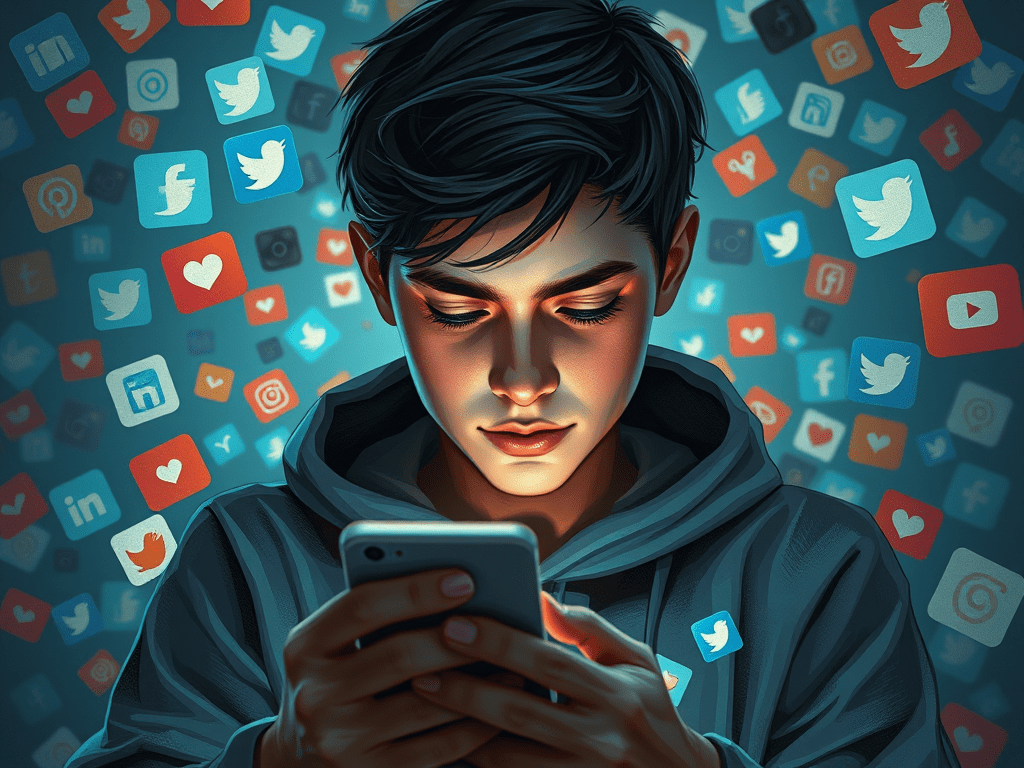
Social media dependency – when appearances and looks is all you know

The so-called social media, online platforms like Facebook, YouTube, Instagram, etc., have been with us for close to 20 years now. Young people born with smartphones, internet access and multiple social media accounts cannot really understand how life was possible before these tools came to be. Life has changed so much over the last two decades that we can’t even begin to comprehend it.

Social media can be used, in moderate dosage, in beneficial ways: for personal growth, for business purposes, to keep connected with friends and family far away. This is not, however, how a lot of people use it. There are already multiple studies, articles, books about how damaging social media usage and dependency can be, especially for children and teenagers. The question is how is it possible for so many people of all backgrounds, to become addicted to this type of content and misuse it so badly?

One possible answer regards the essence/appearance dichotomy. Traditional Christian philosophy makes a clear distinction between essence – “what you really are, your spiritual core” – and appearance – “the outer, material, less significant aspects”. The general advice is to focus more on essence and less on appearance.

The modern mentality is exactly backwards: it doesn’t matter who you are and what you are deep down, it matters only what you project to the outside world. How you look, how much you gain, what you are worth, where you spend your time, who you hang out with, etc., it’s all about external parameters, looks, and appearances.

Social media is all about appearance. With its simplistic algorithms, visual focus, and self-promotional approach, it caters perfectly to this modern mentality: “show yourself”, “express yourself”, “get engaged”, “get connected”, “make an impact”, “share”, “like”, “post”, etc. All of this creates a world where meaningful, profound exchanges and relationships are becoming increasingly rare. The superficial, the vanity metrics, the focus on appearances is seen as the norm.

The more you engage in this type of egotistic social media behavior, the more you become addicted to it and the harder it gets to engage in normal, personal, altruistic relationships. You create your little fantasy world where you are the master, you set the rules and everything happens according to your will. Why wouldn’t you like something like this?

Well, at some point, sooner or later, the bubble breaks and you realize you have invested so much of your time and energy into nothing.


Technology – double edge sword

Technology is usually seen as a cool thing that makes us smarter, faster, richer. In many cases, we actually accomplish things in a faster, smarter way with the help of technology and we become therefore materially richer. Modern societies, from politicians and dictators, to economic players such as companies, to social actors like NGOs, social media, mass media hail the role of technology and always want more of it: more tech, more innovation, more cool stuff.

On the downside, the use of technology often makes us lazier mentally and physically, more superficial, more arrogant and less connected to the truths and realities of this world.

Is this what we really need? You very rarely hear about the downsides of technology. And, when you do hear about it, it’s almost always in the form of a fatalistic lamentation like this: “That’s life, nothing you can do about it”. Well, that’s not actually true, there are things you can do about it.

The first thing you need to know is that technology is a double edge sword. It’s up to you to use the good side and not to use the bad side. If you don’t have this knowledge of what’s good and bad for you, if you don’t have control over the tools, you are better off without. Or you you need to learn.

The news apocalypse

A type of content that is less commonly known to provoke dependency is news. By news, I mean not just the regular news bulletins in the media (TV, radio, social media, Internet) but also any kind of media content about current issues – social, political, cultural, sports, entertainment, etc. One might ask, what harm is there in watching or reading news? The answer is that, like many other forms of content addiction, news addiction leads to serious consequences in the psychological life of those impacted by it. This is not about the occasional, dispassionate consumption of news, but about a full life-altering dependency that changes the way you view yourself and the world.

Imagine for a second how a techalcoholic with a news addiction leads their life. They watch news on the TV while simultaneously reading an article on the Internet. They also check out posts and comments on multiple social media platforms, then revert back to watching talk shows or listening to podcasts on the same topic. They perform these activities almost concurrently, going back and forth from one device to another, from one channel to another, from one piece of content to another. They absorb internally whatever the algorithms and the daily trends and ratings decide is important for that day, like a drug addict consuming the drugs they are addicted to. They are in an informational whirlwind, which takes them mentally from one place to another in an erratic, forced, unstable way. They get a diabolical enjoyment and sense of satisfaction from watching and seeing all the confrontation, misery, and tragedy of the world from their comfortable armchair at home, but this enjoyment doesn’t last very long and is always replaced by an inner emptiness that they cannot hide. They feel satisfied that they are a modern, evolved person belonging to the civilized modern world, unlike those primitive savages in exotic places who are incurring all sorts of catastrophes.

The psychological effects of news dependency are manifold:

  • Superficiality and egotism
  • Overrating and overtrusting their own reasoning abilities
  • Inclination to judge others negatively
  • Seeing evil in everything, including themselves
  • Starting to believe the most ludicrous ideas and theories
  • Being easy to manipulate while considering themselves very smart and educated
  • Experiencing depression, despair, and an apocalyptic state of mind

The problem that techalcoholics have with the news deluge is essentially a matter of perspective. They believe that the more information they have from the outside, the better off they are. But they don’t know what someone like St. John Chrysostom said a long time ago: “Happiness can only be achieved by looking inward [not outward] and this requires transforming greed [incl. greed for information and knowledge] into gratitude”.

Porn – a spiritual atomic bomb

One of the significant achievements of modern technological advancements is the widespread access to content that, from any traditional or classical perspective, would be considered obscene, pornographic, or spiritually harmful. In the past, there was a socially-approved conduct that individuals had to follow to be part of society, which largely prevented the spread of obscenities and pornography among the masses. While it is true that the enforcement of this behavior sometimes went to extremes, modernity has shattered these norms and swung to the opposite extreme, turning obscenity and pornography into a perceived human right.

Obscene and pornographic content can now be accessed by anyone, including children, on any device, at any time. Pornography is perhaps the most accessed type of content on the internet and has become a major cultural trait of our times. Many view it as a legitimate business and a normal form of leisure. What are some of the effects of this on psychological, spiritual, and social levels?

  • Porn is addictive, and addictions are always detrimental in the long run.
  • Porn gradually changes the way you think, often without you realizing it, and affects how you view yourself, others, and the world around you.
  • Porn often impacts you in very tangible ways: you may become fickle, unstable, nervous, impatient, unreliable, moody, weak, and unable to function both mentally and physically.
  • Consumption of porn leads to other sexual deviations and prevents you from living a normal family life.
  • Porn has negative consequences on your social life and how you interact with family, friends, coworkers, and, in the long term, is a major contributor to failure and disappointment.
  • Porn, along with the string of other sexually deviant behaviors it generates, leads to a decline in birth rates and demographic trends, which can be viewed as a form of collective social suicide. If you can fulfill your sexual desires and fantasies independently, without any real connection or relationship, and without any higher goal attached to it, why would you go through the hassle of starting and maintaining a family and perpetuating the species?

An atomic bomb is known for its destructive power in the physical realm, as it destroys everything within its blast range, and the surroundings remain contaminated for many years to come. Porn has similar effects at the spiritual level and leads to the same kind of destruction at the social level in the long term.

Device addictions and content addictions

Techalcoholism manifests in two forms:

  1. Hardware or Device Addictions: This occurs when an individual becomes addicted to a specific piece of hardware, such as a phone, TV, tablet, or car.
  2. Software or Content Addictions: This involves addiction to specific types of content, including pornography, gaming, social media, movies, or news.

Often, individuals develop a combination of both types. For instance, a person may initially use a phone normally but later become addicted to pornography, leading to a content addiction that eventually results in a device addiction, making it difficult for them to live without the phone.

Generally, overcoming device addictions is easier than content addictions. While a device can be physically discarded, content addiction operates on a psychological level, making it more challenging to address. Since most techalcoholics experience a combination of both, effective therapy must incorporate both hard and soft elements. Hard elements involve reducing or eliminating device usage, while soft elements focus on reducing or eliminating the consumption of addictive content and replacing it with more positive activities.

Using the phone – between rational and irrational

If there’s one piece of technology that is universally used and embodies both the positives and negatives of modern advancements, it’s the personal phone. By “phone,” we mean a smartphone—a device equipped with internet and digital communication capabilities. This is what most people carry in their pockets today, and it’s also the type of phone that often leads to user addiction. Older phones, lacking data or internet capabilities, are still used by some but have far less potential to induce addiction.

On the positive side, smartphones enable us to do many things that were previously impossible or much more difficult:

  • Chat or video chat with distant friends from the comfort of our personal space.
  • Use the internet to research specific topics.
  • Utilize maps or GPS to navigate and find locations.
  • Place orders for various services.
  • Watch videos or listen to music during downtime.

Despite these benefits, many of us feel that our phones have become more than just tools and that we often use them negatively. This is likely because we do. There’s a fine line between rational, useful technology use and irrational use, and we frequently cross it—initially unknowingly, but eventually, as addiction sets in, we begin to realize it. Irrational phone use becomes evident when this cool piece of technology turns from servant to master, becoming an extension of ourselves without which we can’t imagine life. Our daily activities revolve around the phone:

  • The first thing we do upon waking is check our phones for updates.
  • We scroll through our phones during breakfast.
  • We listen to music on our phones while commuting.
  • We keep our phones next to us at work, constantly switching between tasks and the phone.
  • We jog with our phones, listening to music.
  • We chat with friends all day through phone apps.
  • We order food via our phones.
  • We pay for everything using our phones.
  • We spend our evenings watching something on our phones.
  • We go to bed after one last check of our chats or social media feeds.

When you think about it, almost everything you do in a day involves your phone. It makes life easier to the point that it becomes a necessary entry point to life, an obligatory part of life—it becomes life itself. When you feel completely lost without your phone, when you can’t go more than 10 minutes without looking at it, when you can’t imagine life without it, your phone use has become irrational. No tool should ever become your master; if it does, you’re already on the wrong side of the fence.

However, there is hope. You can always regain control if you set your mind to it. One possible measure is to block certain hours or days when you don’t allow yourself to use the phone. Another option is to ditch the smartphone altogether and use a feature phone. If you find that the downsides of using a smartphone outweigh the benefits, why keep it? You could keep it in a drawer and only turn it on in exceptional cases when you really need its capabilities.

Effects of techalcoholism

When you encounter someone struggling with alcoholism, you often have a sense of what to expect. Here are some common symptoms associated with a drinking problem:

  • Loss of control: The individual is unable to regulate their drinking habits.
  • Compulsive urges: They experience persistent and overwhelming desires to drink, often to escape reality.
  • Mental health issues: These can include temper tantrums, mood swings, impatience, difficulty concentrating, irrational thoughts, and feelings of hopelessness.
  • Physical health problems: General weakness, reduced strength and flexibility, and various medical issues.
  • Decline in work performance: Their ability to perform at work deteriorates, potentially leading to job loss.
  • Social isolation: They gradually lose friends and family, becoming socially ostracized.

These symptoms are commonly associated with traditional addictions, which are widely recognized by society. However, many people fail to realize that newer forms of addiction, such as “techalcoholism,” exhibit similar symptoms. Consider someone you know who is addicted to their phone, social media, horror movies, pornography, or video games. Depending on the severity of their addiction, they may display many of the same negative psychological and social effects as those with more traditional addictions.

Society has established various institutions and support systems to help individuals with traditional addictions. Yet, there is a noticeable lack of similar resources for those suffering from techalcoholism. I would argue that techalcoholism is one of the most prevalent types of addiction today, and it deserves the same level of attention and support.

Introduction au techalcoolisme

À l’exception de quelques tribus isolées et populations marginales, nous sommes tous plus ou moins dépendants de la technologie. Notre essence en tant que personnes modernes, notre appartenance au monde moderne, est définie par l’utilisation à grande échelle de la technologie, qui nous permet de réaliser des choses qui n’étaient pas possibles auparavant ou l’étaient dans une bien moindre mesure. Cependant, c’est précisément ce caractère essentiel que la technologie a pour la personne moderne, ce sentiment d’être indispensable, qui fait que certains d’entre nous ignorent les risques et dangers qu’un usage imprudent de la technologie entraîne. C’est ainsi que naissent les addictions à la technologie avec tous leurs effets négatifs, c’est ainsi que certains d’entre nous deviennent des techalcoolique.

Natural vs artificial in techalcoholism

Technology creates and brings an artificial layer in our lives. This artificial layer acts as a protective wall between us and the brute forces of nature, but at the same time prevents us from experiencing nature and reality the way they really are. And growth mostly comes from directly experiencing reality. If you’ve lived all your life warming your place through electrical, gas or other means of modern heating technology, you’ve probably never experienced real cold and don’t understand its impact.

Even more so with techalcoholism. A techalcoholic embraces this protective feeling of technology so much that he can no longer do without it. He sees everything through this lens, he does everything through this artificial appendix. We all know people who are completely lost without their phone, or Internet, or their TV set, or favorite slippers, or whatever.

Most people don’t need to give up on technology altogether. Or wouldn’t be able to even if they wanted. A techalcoholic unhappy with his situation can reverse the trend by starting to do more activities which are toward the natural end of the spectrum. If you are socializing only via phone apps, go out and talk to people on the street or in a bar. If you’re addicted to e-games, go and find an engaging physical activity like gardening or do sports. If you spend the whole day inside in front of a computer screen, try to take as many possible breaks to be outside and spend the end of the day being outside or doing some sort of physical activity.

Humbleness and programmatic effort as key remedial methods

Addictions of all kinds do a lot of damage to the human being in its entirety. So does tech alcoholism. Your mind, your thinking, your heart, your feelings, your willpower, your body, all of them are affected in numerous negative ways. When you’ve reached the point where you realize you just can’t control yourself and do things that you don’t want to do, the damage you’ve incurred is already quite serious. At both psychological and physical levels.

There are 2 ways to get out of the chains and break the cycle:

  • Humbleness as a spiritual attitude toward yourself and the world. You need to recognize the state in which you are, you need to recognize that it is your own mistakes and deficiencies that brought you there, and you need to recognize that you need outside help. Humbleness in practice means, for instance, seeking out help in those wiser than you, asking others when you have questions, doubts, not relying too much on your own opinions and ideas.
  • Programmatic effort to tame the impulses of your body, to enable the mind to become purer and regain control of itself, to increase your willpower. Examples of this are fasting, physical work, sports to some extent, prayer and meditation, assisting religious service, occasional refraining from sleep, etc.

A lot of these ideas can be found in a more developed form in the Philokalia, a collection of texts about spiritual warfare and how to grow spiritually. A good intro to Philokalia: https://www.youtube.com/watch?v=lR-lI425KqE